
Solution proposed by : Low Tech Lab
Ekolo Mundo does not control the feasibility or viability of the proposed solutions
Contributor email : hello@lowtechlab.org
Structure : Low Tech Lab


Difficulty level :
facile
In countries where temperatures frequently rise above 20°C, food does not stay fresh for long. A tomato, for example, spoils in just two days. Furthermore, given the cost and energy consumption of a refrigerator, food preservation is a recurring problem in developing countries. Thus, without means of preservation, even if a family living in poverty produces enough food to feed itself, it has few ways to combat hunger.
A system that allows for food preservation can thus greatly improve the daily lives of many families. In particular, it opens up economic opportunities: preserving food also means being able to sell it.
Beyond financial concerns, a family may also seek to reduce energy consumption by opting for natural refrigeration methods, thereby lowering its environmental impact.
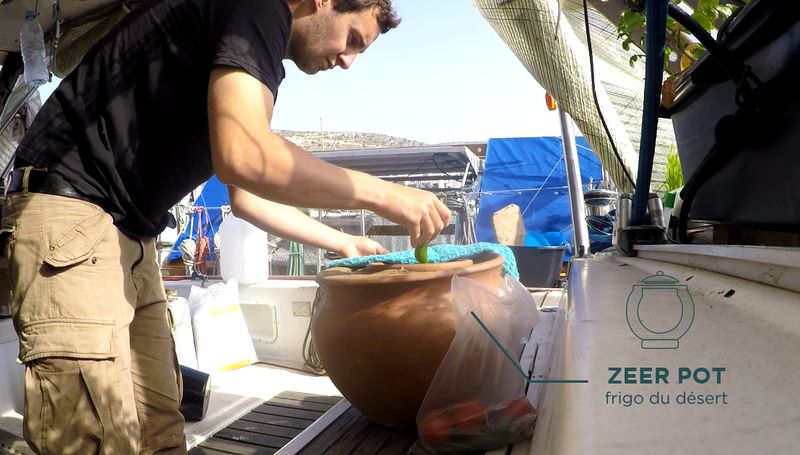
The Zeer Pot—the “desert fridge”—can be a viable solution to this problem. It is a refrigeration device that keeps food cool without electricity, using the principle of evaporative cooling.
This inexpensive and easy-to-make technology can be used to cool substances such as water, food, or temperature-sensitive medications. It helps keep out flies and other insects. Furthermore, when stored in a Zeer Pot, most foods last 15 to 20 days longer than when left out in the open, and vegetables retain their vitamins better. In fact, under the right conditions (explained later in this tutorial), the temperature inside the system can be up to 10°C lower than the outside temperature.