
Solution proposed by : Cyril Mercier
Ekolo Mundo does not control the feasibility or viability of the proposed solutions
Structure : QUAE Publishing


Difficulty level :
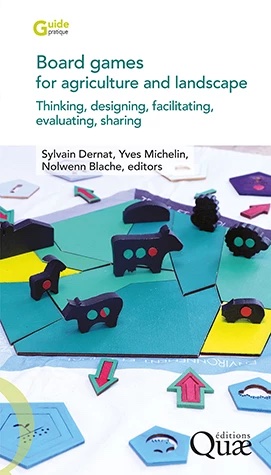
Currently, in France and around the world, there is a significant rise in the popularity of board games centered on agriculture and landscaping. This enthusiasm usually takes the form of isolated initiatives—some successful, others not—involving trial and error. Designing such games can indeed pose numerous challenges for beginners.
This guide aims to build on these lessons to support the design, facilitation, and evaluation of new games in the fields of agriculture and landscape management. The social environment is at the heart of this approach, serving as the driving force behind the game’s mechanics, the learning it facilitates, and the changes in attitudes and actions it generates.
The authors propose a highly practical, methodical approach to designing a game based on an agricultural or landscape issue, covering everything from theoretical concepts to the evaluation of the final product. Each chapter details a concrete case study to provide a better understanding of the design process. The authors’ decades of experience inform the development of this methodology, ensuring that this guide can be used in the field by as many novice designers as possible.
TABLE OF CONTENTS
Preface
General
Introduction Part 1. Understanding Board Games to Design
Them Better 1. Key Concepts to Know Before Designing a Game
1.1. What Do the Sciences of Games (Ludology) and Play Tell Us?
1.2. The Five Dimensions of Play
1.3. What Is a Serious Game?
1.4. What Is a Board Game?
1.5. Games as a Medium for Revealing or Transforming Social
Space 2. The Unique Characteristics of Games About Agriculture and Landscape
2.1. Playing with agriculture: a timeless classic
2.2. The many complexities of agricultural
activity 2.3. Playing with the landscape adds further complexities
3. An Attempt at a Typology of Board Games Designed for Agriculture and Landscape
3.1. Level 1. Learning or raising awareness through board
games 3.2. Level 2. Understanding and recognizing oneself to develop the ability to “work together”
3.4. Level 3. Cooperating and committing to “developing a project”
3.5. Level 4. Preparing for and experimenting with real-world
practice. A common thread throughout Part 1
. Part 2. Designing and Creating a Game. 4
. Before You Begin
. 4.1. What is the game’s theme?
4.2. What are the objectives?
4.3. Who is the target audience?
5. Simplifying Reality Through Modeling
5.1. How to Prepare the Conceptual Framework of the Model?
5.2. How to Organize Knowledge as a System?
5.3. How to Account for Spatial Dynamics?
5.4. How to Account for Social Phenomena?
5.5. Where should decision-making centers be integrated?
5.6. How should the model be calibrated?
6. Creating the Game
World 6.1. Who are the players? Who are the agents?
6.2. How do players interact with one another: competition or collaboration?
6.3. How should spatial dimensions be represented on the game board?
6.4. How should temporal dimensions be integrated into the game?
6.5. What role should chance and the fun of playing play?
7. Transforming the Model into a Game
7.1. How do we move from the model to the game components?
7.2. How can the flow of materials and information be represented and managed?
7.3. How should the game rules be defined?
7.4. How can the game be made more exciting?
8. Testing the game and considering necessary
improvements 8.1. Does the game’s “engine” work properly?
8.2. Are the game rules clear?
8.3. Does the game flow smoothly?
8.4. Are the game elements practical?
8.5. Is the playtime reasonable?
8.6. Does the game perform well?
9. Turning a Game That Works Into a Game People Enjoy
9.1. Why Is It Important to Pay Attention to Graphics?
9.2. The Special Case of “Sad”
Games 9.3. Are the Graphics Consistent with the Message Conveyed by the Game?
9.4. Does the game resonate well with its audience?
Overarching theme of Part 2
Part 3. Facilitating, Evaluating, and Sharing a Game
10. Facilitating a Game
Session 10.1. Some Theoretical
Guidelines 10.2. Preparing the Game
Session 10.3. The Facilitator’s
Roles 11. Evaluating the Game
11.1. Some Principles of Validity for Understanding Reality
11.2. Defining Your Evaluation: Understanding Reality
11.3. Defining Levels of Evaluation
11.4. Tools for Evaluation
12. Developing a Strategy for Distributing the Game
12.1. Promoting Your Game: Questions to Ask and Considerations to Anticipate
12.2. Step A. Characterizing the Game to Guide Promotion and Define an Action
Plan 12.3. Steps B1 and B2. Who Owns the Game and How to Protect Your Serious Game?
12.4. Step C. Distributing Your Game
Key Themes of Part 3
Conclusion
Publisher: Editions Quae
Series: Practical Guide
Publication Date: August 31, 2023