
Solution proposed by : Cyril Mercier
Ekolo Mundo does not control the feasibility or viability of the proposed solutions
Structure : UNESCO Chair on World Food Systems


Difficulty level :
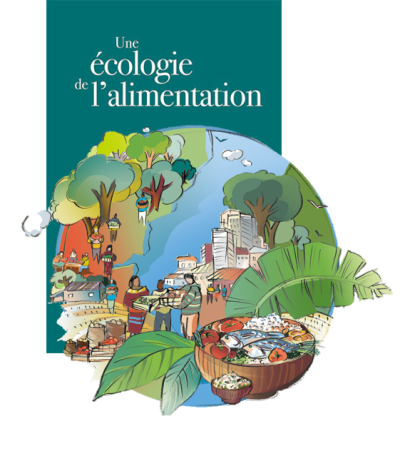
Rethinking our diets means rethinking our societies. Because sharing a meal—and even going grocery shopping—are ways to connect with others. The way we eat shapes our health. Our agricultural production methods shape our landscapes and define our place in nature. Managing resources to produce, process, and distribute food forms the foundation of our economies. Our food traditions, cuisines, and table manners reflect our cultures. Finally, and most importantly, eating is a pleasure… By recognizing all these dimensions as equally important, this book addresses contemporary food issues. The proposal for a food ecology is rooted in both the science of relationships and political engagement. Such an approach allows us to revisit—sometimes in unexpected ways—the guiding principles of sustainable food systems. It also aims to support civic, public, and private initiatives committed to transforming food systems.
Part expert essay and part illustrated account of examples drawn from around the world, this book is intended for both professionals and the general public curious about issues of sustainable food.
An anniversary publication of the UNESCO Chair on World Food, which has been breaking down barriers to knowledge about food for the past 10 years.
Bricas, N., Conaré, D., Walser, M. (eds.), 2021. An Ecology of Food. Versailles, Quæ Publishing, 312 pp. DOI: 10.35690/978-2-7592-3353-3
Preface—Claude Fischler
Introduction: Food in All Its Dimensions—N. Bricas, D. Conaré, M. Walser
Part 1: Food as Relationships
1. Food as a Means of Connecting with Oneself
—M. Walser, T. Fournier, N. Bricas
2. Food as a Means of Connecting with Others
M. Walser, N. Bricas
3. Food as a Means of Connecting with the Biosphere
M. Walser, N. Bricas, D. Conaré
Part 2: Challenges of the Contemporary
Food System 4. The Origins of Industrial
Agriculture B. Daviron
5. The Industrialization of the Food
Supply N. Bricas, D. Conaré, M. Walser
6. The Evolution of Eating
Habits N. Bricas, M. Walser
7. The Limits of Industrialized
Food Systems N. Bricas
Part 3: Food Through an Ecological
Lens 8. Why an Ecological Approach to Food?
M. Walser, N. Bricas, D. Conaré
9. Breaking Down Silos in Food
Knowledge J.-M. Louvin, M. Walser
10. Committing to the Transformation of Food
Systems D. Conaré, N. Bricas, M. Walser
Part 4: Discussing the Key Issues of Sustainable
Food 11. Should we double food production?
N. Bricas, E. Malézieux
12. Fortifying foods to combat deficiencies?
S. Avallone, A. Alpha, N. Bricas
13. Would you like a little more protein?
O. Lepiller, E. Fourat
14. Combating food waste?
M. Mourad, N. Bricas
15. Combating food insecurity through food aid?
P. Scherer, N. Bricas
16. Reviving home cooking and “homemade” food?
A. Dasgupta, H. Zirari, N. Bricas, M. Walser, A. Soula
17. Moving Away from Local Food?
D. Conaré, N. Bricas
18. The “Consum’actor”: A Driver of Change?
N. Bricas
Part 5: A Food Ecology to Transform Food
Systems 19. Citizen Initiatives and Scaling Up
N. Bricas, M. Douillet
20. Businesses: Toward New Models?
M. Kessari, M. Marais, M. Meyer, F. Palpacuer, L. Temri, M. Walser
21. The Roles of Education and Research
N. Bricas, S. Fournier, O. Lepiller, E. Valette
22. Food in Public Policy
N. Bricas, D. Conaré
Conclusion: Food Is an Encounter with the World… Everyone
N. Bricas, D. Conaré, M. Walser
The UNESCO Chair in World Food Systems was established in 2011 by Prof. Jean-Louis Rastoin (Montpellier SupAgro, now Institut Agro Montpellier) with a multidisciplinary group of faculty and researchers from various Agropolis International institutions. It was accredited by UNESCO and received its main financial support from the Agropolis Foundation and the Daniel and Nina Carasso Foundation.
This support enabled the launch of training, research, and dialogue initiatives between science and society within an international scientific network that is broadly open to Africa, Asia, and Latin America.
At the end of its first four years of activity, the Chair was once again accredited by UNESCO in July 2015 for a second four-year term, and again in 2019.
The Chair serves as an open, cross-disciplinary space for exchange and experimentation, contributing to the development and promotion of an alternative food system.