
Solution proposed by : GRET
Ekolo Mundo does not control the feasibility or viability of the proposed solutions
Structure : GRET


Difficulty level :
facile
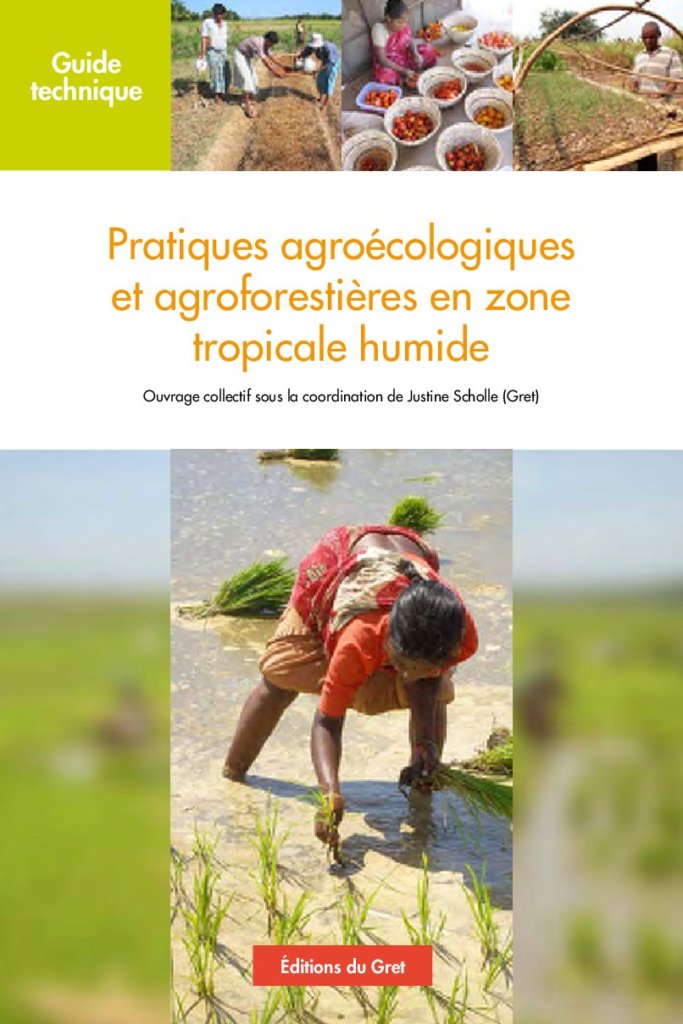
This guide is designed as a resource for technicians and farmers involved in promoting and developing agroecology.
It follows up on an initial technical guide produced in 2014 in the Democratic Republic of the Congo as part of the Defiv project, a food security initiative implemented by GRET and funded by the European Union and the French Development Agency.
As part of this project, farmers in Mayanda, an agricultural area located on the outskirts of Boma in Bas-Congo, received support in agroecology and agroforestry. New techniques were proposed and tested in farmer demonstration fields, then on plots belonging to pilot farmers. Techniques that proved successful were subsequently promoted throughout the area. The farmers then expressed a desire for a written guide documenting the technical protocols and know-how developed as part of the project. They wanted to be able to refer to it when needed. A booklet was then written in Kikongo, the language of Lower Congo. It included numerous illustrations so that people with little or no literacy could use it.
Beyond this African region, it became apparent that technicians and farmers engaged in promoting agroecology in humid tropical zones had little technical information that could be easily and quickly accessed in the field. This is how the idea for this guide was born, aimed at meeting their needs.
This guide is divided into two parts.
The first part presents the context and current challenges of agroecology in humid tropical regions. After highlighting the limitations of conventional agricultural systems and analyzing the effects of deforestation, the Green Revolution, and climate change, the authors outline the objectives and principles of agroecology and outline the conditions for its promotion. 8 Agroecological and agroforestry practices in humid tropical zones
The second part, which is highly practical, addresses various agroecological techniques that have been tested in a humid tropical context and have yielded satisfactory results, whether in the Republic of the Congo (Defiv project), Cambodia (Apici project), or Myanmar (Delta and NRS projects). The first section outlines various agroecological techniques, and the second presents the plants used to implement these techniques. Of course, neither the techniques nor the plant inventories mentioned in this guide are exhaustive.
Each fact sheet—whether it covers a technique or a plant—outlines the advantages and disadvantages of the subject at hand.
The technique sheets specify their various functions. Each technique may have one or more cross-cutting functions. However, to make reading easier, they have been grouped according to their main function into seven categories:
Each technique is described in detail and illustrated with diagrams and photos. Bibliographic references are provided for further reading.
Difficulty level: Easy