
Solution proposed by : CAUE Occitanie
Ekolo Mundo does not control the feasibility or viability of the proposed solutions
Contributor email : caue@caue31.org
Structure : CAUE OCCITANIE


France
Occitanie
Difficulty level :
facile
The CAUE (Council for Architecture, Urban Planning, and the Environment) is a public service organization entrusted with a mission of public interest. Its objective is to promote quality in architecture, urban planning, and the environment within departmental territories. The CAUE was established at the initiative of local officials. It serves as a forum for consultation among stakeholders involved in the development and management of rural and urban areas. It also functions as a resource center for information exchange, dissemination, and decision-making support for individuals, elected officials, and businesses alike.
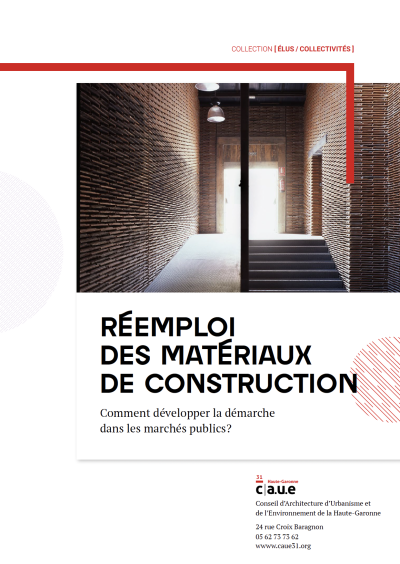
THE GUIDE TO THE REUSE OF BUILDING MATERIALS
While the reuse of materials has been ubiquitous throughout history, it declined significantly during the 20th century, largely due to the increasing mechanization of demolition sites and the gradual rise in labor costs.
It is therefore not so much a matter of inventing reuse as it is of rediscovering it, bringing it up to date, exploring its qualities, and understanding its specific characteristics.
Environmental Challenges
While there is broad consensus on the challenges of resilience, the transition from a linear production and consumption model to a circular resource management model is struggling to gain traction. This is particularly true for the construction materials reuse sector, which accounts for over 70% of total waste production in France. Beyond waste, the construction sector is responsible for nearly a quarter of greenhouse gas emissions in France. In the case of new construction, analyses show that half of a project’s CO2 emissions are linked to materials
Heritage Challenges
When it is absolutely impossible to maintain an existing building, keeping its components in circulation is a way to preserve its memory. Specialized suppliers preserve artisanal know-how and knowledge of materials and construction techniques that reflect a shared and precious heritage.
Social challenges
Reuse promotes local and artisanal skills. The jobs created are part of a specific ecosystem and cannot be outsourced. This practice requires specific skills: selective demolition, reconditioning, and the sale of materials. In some cases, the reuse of finish materials may also be intended for resale to private individuals, thereby allowing residents to access products at a lower cost
Difficulty level: Easy