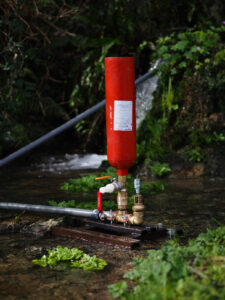

Solution proposed by : Chemins de Faire
Ekolo Mundo does not control the feasibility or viability of the proposed solutions
Contributor email : contact@cheminsdefaire.fr
Structure : Paths to Follow


France
Difficulty level :
expert
In any project focused on self-sufficiency, water plays a central role—whether for drinking, household needs, or irrigation. There are many ways to collect or transport water; however, when it comes to pumping, the issue of powering the pump can sometimes pose challenges, especially in remote areas.
During a visit to the Sunseed Tecnología autonomous community in Andalusia, we discovered ram pump technology. This type of pump allows water to be lifted from a watercourse mechanically, by utilizing a physical phenomenon of fluid compression.
Here, we present the construction of a ram pump using plumbing components, inspired by a tutorial published by the Lowtech Lab. For more information, feel free to visit the website of Didier Nebreda, an expert in hydraulic rams.
A ram pump is a type of lift pump; it allows water to be transported upward from a lower-lying water source. In theory, the lift height is determined by the head: if water falls 1 meter into the pump body, it can be lifted 10 meters. A ram pump works only with flowing water: it requires a high water flow rate and cannot operate in stagnant water.
PRINCIPLE OF OPERATION
Operation and details of the components of the hydraulic ram
Thanks to a water retention tank or buffer tank placed above the pump, water is fed into the pump body via a pressure pipe, the water flows out abundantly through the surge valve until the pressure causes the well-known water hammer. The water hammer effect causes the check valve to close and compresses the water inside the pump body. Under the effect of the pressure, the check valve allows a small amount of water to pass into the air chamber, and the shock valve opens again. The water in the air chamber is pressurized and can only escape through the discharge line.