
Solution proposed by : Cyril Mercier
Ekolo Mundo does not control the feasibility or viability of the proposed solutions
Structure : INRAE


France
Difficulty level :
moyen
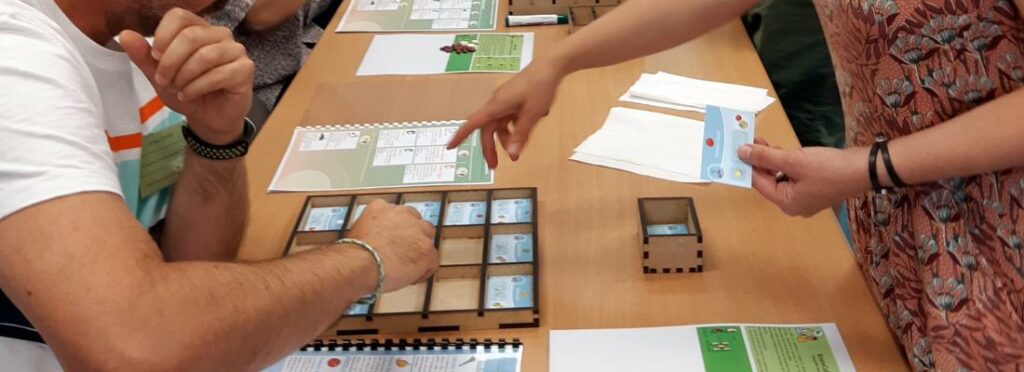
La clé du sol is a free role-playing game available in French or English, designed to help students in agricultural and environmental training programs retain knowledge. By immersing participants in real-world situations encountered in vegetable farming—specifically regarding the challenges of agroecological soil management—the game confronts them with challenges and encourages the exploration of innovations involving multiple actors within the socio-technical system.
The socio-technical barriers hindering the transition to more sustainable agricultural systems have been extensively documented in the scientific literature, both as theoretical concepts and case studies. However, these lock-in phenomena remain difficult for agricultural students to grasp, due to their systemic nature, which extends far beyond the simple framework of agricultural production. Lock-in refers to a situation in which the development of alternative technologies (such as agroecological practices) is hindered by the persistence of the dominant socio-technical system, consisting of a stable network of actors, their practices, their knowledge, the technologies they use, their collective representations, as well as the norms and rules that govern them.
Based on a socio-technical analysis conducted by Yann Boulestreau (UR Écodéveloppement, Avignon) as part of his doctoral thesis on innovation for agroecological soil management in market gardening, the game allows players to experience the most common barriers to the agroecological transition. It is based on the case of soil-borne pest management in Provençal protected vegetable farming and faithfully reproduces the obstacles faced by various stakeholders in the vegetable farming sector as they begin the transition to agroecological practices. Initially used to facilitate workshops on understanding lock-in processes with industry stakeholders, the game was subsequently tested with students. Its educational value subsequently led to the development of a professional version designed to facilitate greater adoption by teachers.
Through the immersion provided by the game (game board, role-playing), participants can grasp the mechanisms that hinder the adoption of agroecological practices for preserving the health of vegetable garden soils. Understanding the specific challenges of the agroecological transition facilitates the assimilation of general knowledge in this field. Furthermore, this understanding encourages the exploration of innovative solutions involving multiple stakeholders to resolve the problems identified during the game.
As part of a comprehensive educational program, the game is preceded by a presentation of the context and its challenges. In a third phase, a debriefing session allows participants to reflect on their experiences and discuss what they have learned.