
Solution proposed by : CIRAD
Ekolo Mundo does not control the feasibility or viability of the proposed solutions
Structure : CIRAD


France
Difficulty level :
facile
Purpose of the Guide
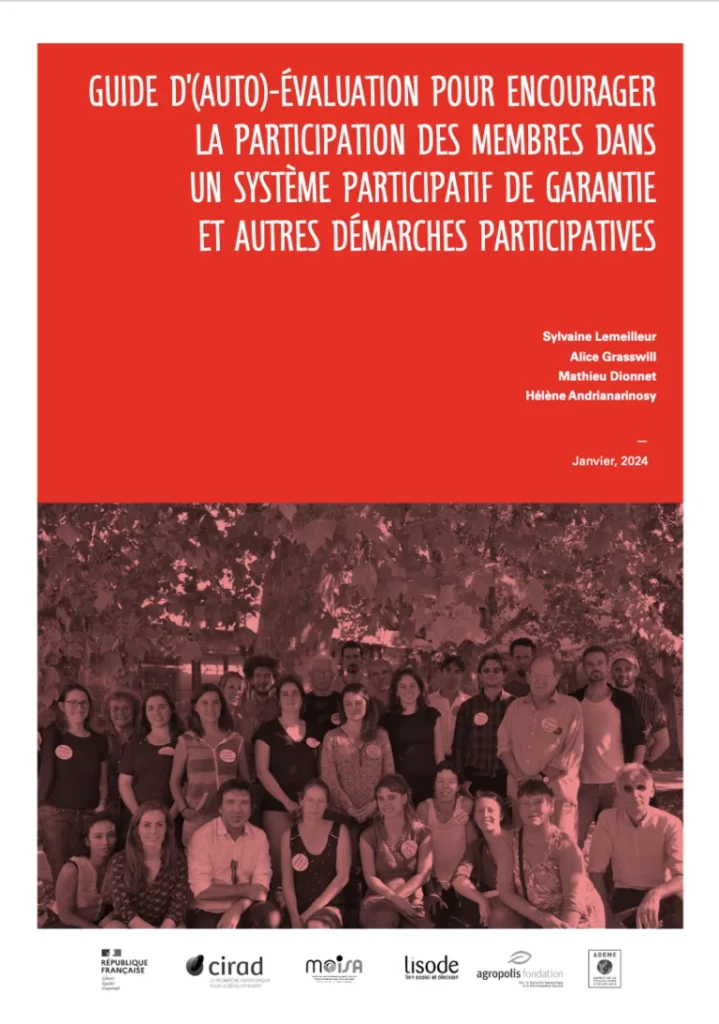
The purpose of this guide is to help Participatory Guarantee Systems (PGS) or other participatory initiatives based on active member involvement to self-assess their participatory functioning, with the aim of improving it.
PGSs provide a non-commercial certification service based on the evaluation of participants by their peers and sometimes other stakeholders in the relevant community to ensure compliance with the requirements of the specifications. To this end, PGSs face a number of challenges in how they self-organize, the main one being ensuring and maintaining the level of peer participation. Participation is understood as a voluntary investment of time and responsibility on the part of individuals, and offers both individual and collective benefits. Like all peer-to-peer models (Bauwens et al., 2019), participation—which can be considered volunteer work—is an essential element of how these structures operate and, at times, of their economic model and thus their sustainability. According to Zask (2011), participation can be defined as “taking part,” “contributing to,” and “benefiting from.” The drivers of participation in peer-to-peer models are numerous (altruism, reciprocity, social image, reputation, personal development, ideological motivation, etc.) (Benkler, 2016) and are shaped by socio-cultural contexts. In this guide, we will focus on providing the material and intellectual resources needed to nurture the natural inclination to participate in a collective project.
In this guide, we explore two levels of participation: individual involvement (Part 1 of the guide) and group involvement (Part 2 of the guide). We propose analyzing this involvement by considering various individual parameters (availability and distribution of the workload, level of commitment to the system, etc.) and collective parameters (how meetings and decision-making are facilitated, how personal conflicts are mitigated, how information flows, etc.).
There is no universal formula for achieving effective participation. Therefore, this guide is not prescriptive and does not aim to define the best way to encourage participation. It is based on a set of questions to consider for improving motivation and incentives for participation in practical terms. It provides a framework for reflection and points of focus that can contribute to a change process. It should be noted that in some cases, the organizational design of the process does not allow for the improvement of certain operational aspects without making more fundamental changes (changes to bylaws, internal regulations, etc.).
This guide is the result of research based on a series of interviews and literature review (page 47: Methodology for developing the guide). Two analytical frameworks guide this work. The contribution of the psychological perspective developed by Spreitzer (1995) on the ability to act, which identifies four key elements: 1– The sense of meaning (i.e., the alignment between the rules, values, and behaviors of individuals within the organization, as well as the perception of reciprocity, justice, or the sense of acting in the public interest, for example) 2– The sense of competence (i.e., mastery of the skills necessary and sufficient to meet expectations, as well as a sense of legitimacy) 3– The sense of self-determination (i.e., having sufficient autonomy and control in participating in activities) 4– The sense of impact or belonging (i.e., the perception of having an influence on the group’s decisions, or of feeling heard within the group).
This initial framework is complemented by the success factors of the commons—such as collective action here (Lemeilleur, 2020) – as outlined by Ostrom (1990), including the presence of rules well-suited to the needs and conditions of participants, a system allowing individuals to regularly participate in defining and modifying the rules, a system with low — 5 (Self-)Assessment Guide to encourage member participation in a participatory guarantee system and other participatory initiatives Each positive response guides you to the next via the dotted lines. conflict resolution system with a graduated system of sanctions. Ostrom also emphasizes that collaboration and adherence to a group’s rules are strongly correlated with face-to-face interaction and a friendly atmosphere.
Beyond GSPs, this guide can also be used for other forms of self-organization based on active member involvement (cooperative supermarkets, participatory daycare centers, community cafés, participatory housing, etc.). The questions will then need to be adapted to these specific cases.
Difficulty level: Easy Tools and supplies needed: Use of the guide The arrowed flowchart guides the assessment of various situations involving the expected participation of one or more members by posing a series of questions to reflect on and discuss collectively how to generate and encourage this participation. Some questions may not be relevant in certain situations and should be disregarded.Note: The guide is not organized in the order of the questions. It can be read in a different order. Each positive answer leads you to the next one via the dotted lines. (For negative answers, read the note and proceed to the next question via the dotted lines.) In some cases, known alternatives are suggested to users.