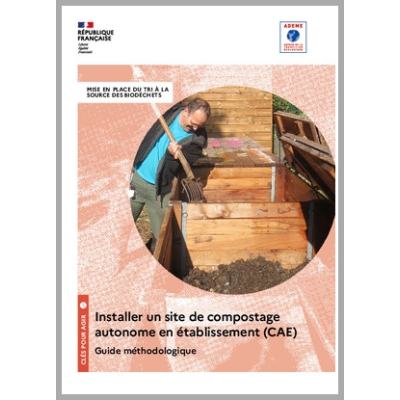

Solution proposed by : ADEME
Ekolo Mundo does not control the feasibility or viability of the proposed solutions
Structure : ADEME


France
Difficulty level :
One-third of household waste consists of various food scraps. These materials, commonly referred to as “food waste,” once decomposed and processed, become a resource for improving soil quality: compost.
To promote its return to the soil and in line with the Law on Energy Transition for Green Growth (LTECV), which requires producers to sort their food waste at the source, the Anti-Waste Law for a Circular Economy (AGEC) lowered the threshold for source separation for large producers to 5 tons as of January 1, 2023, before extending this requirement to all food waste producers effective January 1, 2024.
Among the reasons for taking action are:
z Environmental reasons: development of the circular economy, reduction in waste volume (currently mostly incinerated or landfilled), improvement in soil quality (less susceptible to drought and erosion, reduced reliance on chemical fertilizers, carbon sequestration, etc.);
z Social reasons: bringing meaning to one’s professional life, skill development, etc.;
z Economic and regulatory reasons.
On-site composting (CAE), like other local bio-waste prevention and management solutions (PGprox1), addresses these challenges by enabling the use of compost in the soil as close as possible to where it is produced, most often in urban or suburban areas.
For ease of reading, the term “compost” will be used in this document, although this is a technical inaccuracy from the perspective of current regulations2.
Why this guide?
Facilities that generate bio-waste lack knowledge about composting, and the information available in abundance on the internet or other media is not necessarily reliable or objective. That is why this guide is here to help them make an informed choice regarding its benefits and the potential constraints involved, as well as to highlight possible actions for bio-waste recovery.
This new edition is a tool to support facilities in finding on-site solutions that can both meet regulatory requirements and fit into a virtuous environmental and social approach.
Who is it for?
This guide is intended for any institution, public or private, that wishes to manage its kitchen and table waste (hereinafter KTW) on-site.
This includes: schools, social or medical facilities, permanent or temporary reception centers, restaurants or hotel-restaurants, company cafeterias, recreation or vacation centers, military bases, correctional facilities, and commercial buildings with or without institutional food service, etc.
Key decision-makers and stakeholders include: school principals, kitchen managers, financial managers, facility staff, technical services... as well as local authorities responsible for public institutions with these characteristics.
Since the first CAE guide published by ADEME in 2012, the practice has become widespread, and feedback gathered over significant periods of time can now be analyzed.