
Solution proposed by : Terre et Humanisme
Ekolo Mundo does not control the feasibility or viability of the proposed solutions
Structure : Earth and Humanism


Difficulty level :
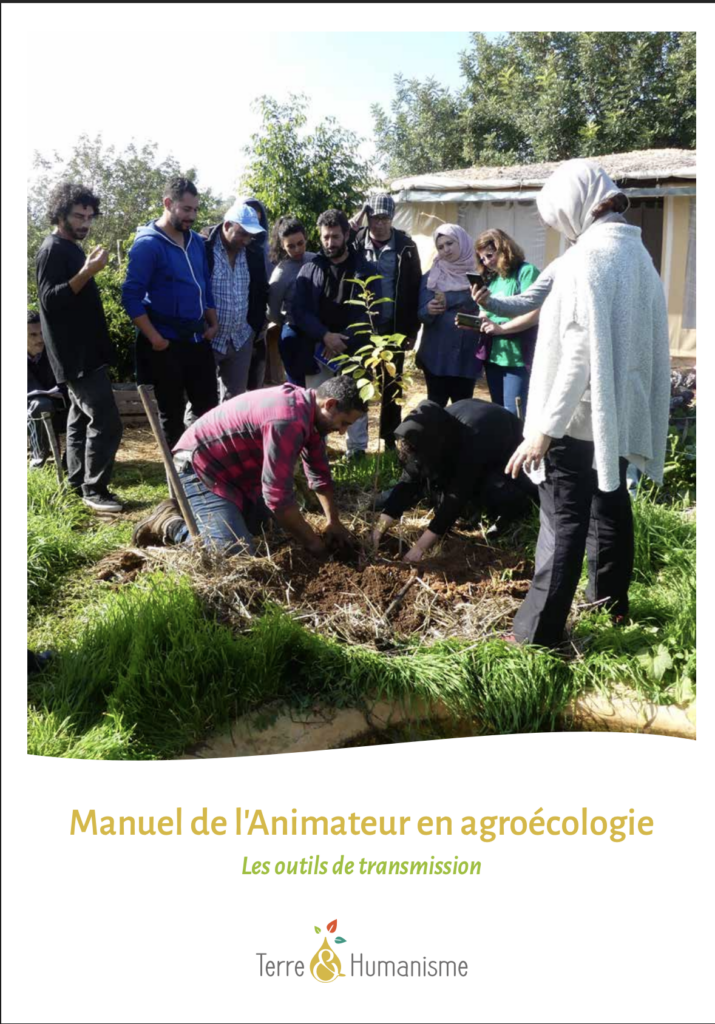
The publication of the Agroecology Facilitator’s Handbook is the result of a collaborative effort carried out with Mediterranean facilitators supported by Terre & Humanisme in 2019. It provides a description of the role of an agroecology facilitator, as well as a set of tools and examples of facilitation activities designed to facilitate exchanges among people wishing to engage in agroecological initiatives.
This guide contains examples of facilitation activities tailored for different audiences—farmers, facilitators, project leaders, agricultural technicians, and even schoolchildren and students—simplifying them for each group.
Anyone wishing to use the tools described here must first adapt them to their own context. This involves tailoring them to each situation and context, taking into account the time available, the size and composition of the group, the participants’ level of knowledge, the materials at hand, and the available space.
Terre et Humanisme uses and disseminates a wide range of tools and learning methods in its agroecology facilitator training programs, which have been organized for over 10 years in France, West Africa, and the Mediterranean region. We encourage the widest possible dissemination of these tools and their use in both rural and urban settings, in the Global North and South, in order to spread the values of agroecology across the planet.
Table of Contents
p. 5 Agroecology: A Holistic Approach
p. 6-7 Definition of the role of an agroecology facilitator
p. 6 The inner mindset
p. 7 Attitudes toward the group
p. 7 Expertise
p. 8 Training Facilitators at Terre&Humanisme
p. 9 The facilitator’s tools
pp. 10–17 A. Tools for Self-Awareness and Accepting Differences p. 10 Character Tree
p. 11-12 Photo language
pp. 13–14 Vision & Perception
pp. 15–16 Proverbs p. 17 Nine Points
pp. 18–30 Participatory Tools for the Facilitator
pp. 18–19 Word associations
pp. 20–21 Moving debate
pp. 22–23 Problem-Solving
pp. 24–25 Q Sort pp. 26–27 Post-it notes
pp. 28–29 Brainstorming
p. 30 Knife game
pp. 31–38 C. Living Tools!
pp. 31–32 Living Picture
pp. 33–34 Canvas of Life
pp. 35–36 Theater
pp. 37–38 Drawing p. 39 Conclusion
By promoting agroecology in both the Global North and South, the Terre et Humanisme association works to educate and raise awareness among small-scale farmers and the general public to support and advance the agroecological transition.